Mold moves fast in Florida humidity, and most of it starts behind something. We handle mold removal, testing and remediation across West Palm Beach and the rest of Palm Beach County. Call and describe what you are looking at. We will tell you straight whether it is a job for us.
Not sure if we cover your area? Call us to find out!
Mold removal services we provide
From hidden growth to full-scale remediation
We handle every stage of mold removal in West Palm Beach, from initial mold inspection and testing to complete remediation and property restoration.
Mold inspection in West Palm Beach
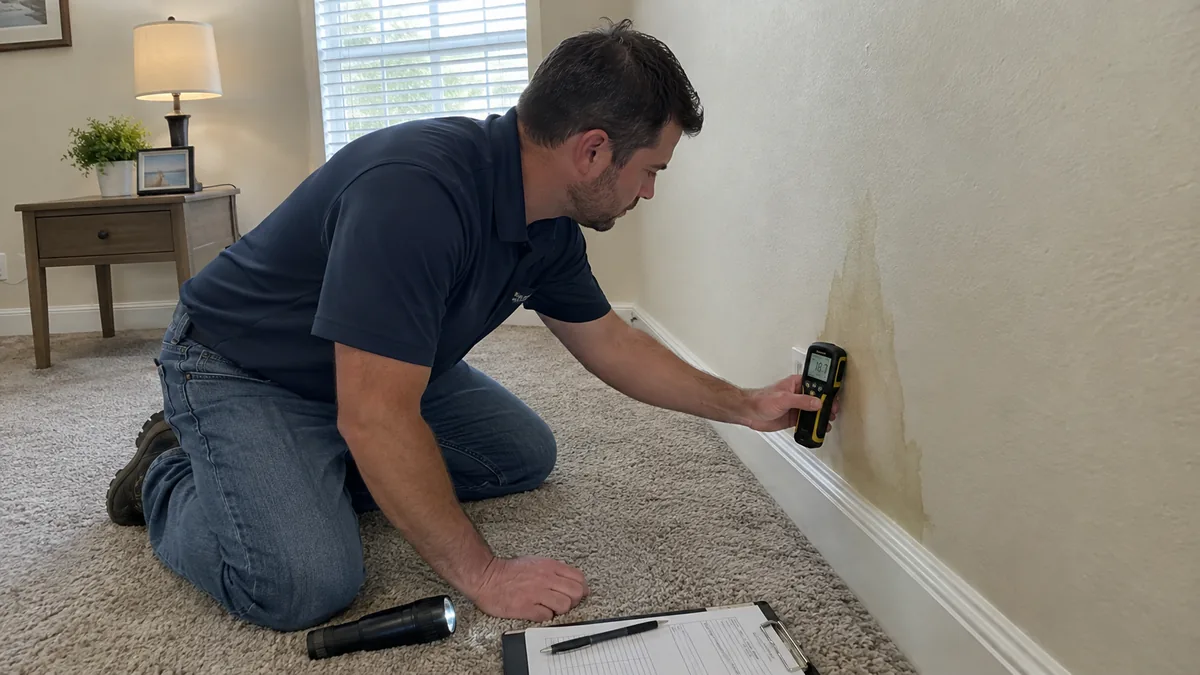
A scoping inspection is the foundation of effective remediation. Our team uses thermal imaging to detect temperature differentials behind walls and ceilings, and professional moisture meters to measure saturation levels in drywall, wood and floor materials, so the moisture source is found before any work starts.
Where laboratory testing is needed, air and surface sampling is handled by an independent licensed assessor, which keeps the result impartial.
Mold can spread in as little as 48 hours after water intrusion. Our emergency team responds to urgent situations - post-storm flooding, burst pipes, sewage backups, or any scenario where mold contamination must be contained immediately. We deploy containment barriers and air scrubbers within hours to stop mold spores from spreading to clean rooms throughout your house.
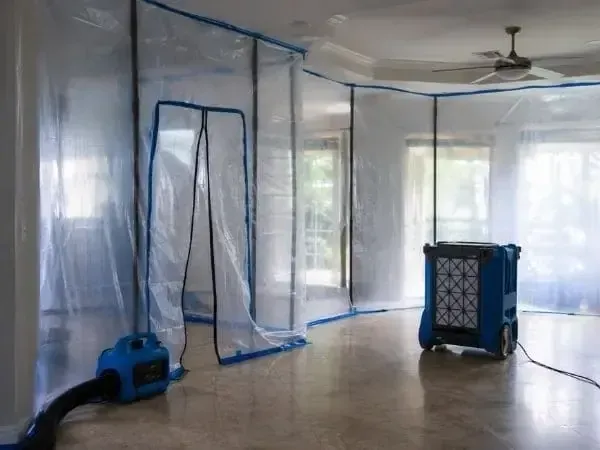
Full-scale mold removal following IICRC S500 and S520 standards that guide professional mold remediation practices. The process includes physical containment with 6-mil poly barriers and negative air pressure, HEPA air scrubbing and filtration, safe removal and disposal of contaminated materials, antimicrobial treatment of structural surfaces, and complete drying to bring moisture content below critical thresholds.
Discarding porous materials contaminated with mold - such as drywall, carpet and insulation - is necessary for effective remediation.
Black mold removal
Black mold is a description of color, not a species, and several common molds look the same on a wall. What matters for the work is that dark growth usually means a surface has been wet for a sustained period rather than briefly, so the moisture source is typically still active when we arrive.
The removal is the same contained process regardless of species: isolate the area, manage the air, cut out porous material rather than treat it, then fix the water. Identifying an exact species rarely changes any of that.
Once remediation is complete, we restore your property to its pre-damage condition. This includes replacing drywall, flooring, insulation and painting, plus installing moisture control solutions like improved ventilation, dehumidifiers and sealed building envelope repairs to mitigate the risk of future mold growth. The EPA recommends controlling indoor humidity below 60%, and we install or recommend dehumidification systems to help maintain that standard.
Insurance claim support
We work directly with your insurance company, providing the documentation, moisture readings, photographs and lab reports they require. This makes the process less stressful and helps ensure your claim is covered. Many residential insurance policies cover mold damage when it results from a covered peril like a burst pipe or storm damage.
Mold testing in West Palm Beach
Mold testing measures what is in the air or on a surface, through air and surface samples read by an accredited laboratory. It is worth doing when growth is hidden, when a problem has to be documented for a sale or an insurer, or to confirm an area is clear after remediation.
Clearance testing after our work is carried out by an independent licensed assessor, not by us, so the sign-off stays impartial.
Not sure what you need? Describe what you are seeing and we will advise on the phone, at no charge.
Call (561) 529-5430
Locally owned
& operated
Fully insured
Every job covered
Workmanship
Guaranteed
Upfront pricing
No hidden fees
Free inspection
No obligation
Know the warning signs
Six signs you may have a mold problem
Mold often hides behind walls and under flooring long before it becomes visible. In West Palm Beach's tropical climate, where average humidity sits between 72 and 75% year-round, that hidden growth can take hold faster than most homeowners expect.
Persistent musty smell
A damp, earthy odor that lingers no matter how much you clean. This is often the first sign of hidden mold behind drywall or under carpet, especially in humid rooms. Exposure to mold can cause health effects ranging from allergic reactions to respiratory problems.
Visible discoloration on walls or ceilings
Dark spots, streaks or fuzzy patches on walls, ceilings or grout. Color can range from black and green to white and orange, depending on the species and surface material.
Recent water damage or flooding
Any water event - a roof leak, burst pipe, or storm flooding - that was not fully dried within 48 hours. In West Palm Beach's humidity, mold spores can colonize damp materials even faster than that.
Unexplained allergy symptoms
Coughing, sneezing, wheezing, watery eyes, skin irritation or sinus congestion that worsens indoors but clears up when you leave. People with compromised immune systems, young children and the elderly face greater risks, including potential respiratory infections.
Peeling paint or bubbling wallpaper
Moisture trapped behind wall surfaces causes paint to peel and wallpaper to bubble or lift. This usually means water is collecting inside the wall cavity where mold thrives in exactly the conditions found across Palm Beach County homes.
HVAC smells different when running
A musty or stale smell when the air conditioning kicks in points to mold inside ductwork or on the evaporator coil. In South Florida homes, HVAC systems run constantly and circulate spores throughout the house if contaminated.
Same-day where we canFast response across Palm Beach County
Insured workEvery job covered before we start
Straight pricingAgreed before any work begins
Why West Palm Beach chooses us
Deep local expertise. Backed by real work.
West Palm Beach is not like other cities. Our tropical rainforest climate, older housing stock with wood framing and stucco exteriors, hurricane exposure and heavy reliance on air conditioning create a variety of mold challenges that generic remediation companies simply do not understand.
We know where mold hides in South Florida homes: behind bathroom tile, inside HVAC ductwork, beneath carpet and floor systems in older Flagler-area houses, and in attic insulation saturated by roof leaks.
Across neighborhoods like Northwood, Flamingo Park, El Cid, Grandview Heights, Prospect Park and the Downtown waterfront district, we regularly find mold in places that visual inspection alone would never reveal. More about how we work, including the parts of a job we deliberately hand to someone else.
Insured
Every visit is covered before we touch anything.
Genuinely local
Based in West Palm Beach, not dispatched from out of county.
Fast response
We aim to be on-site as quickly as possible for urgent situations.
Written guarantee
If it is not right, we come back and fix it.
Advanced equipment for complete detection
Thermal imaging cameras, digital moisture meters and air quality testing locate hidden water damage and mold growth behind walls, under flooring and inside building cavities. Mold inspections help identify hidden water sources that fuel ongoing contamination, and our equipment finds problems that surface-level checks miss.
Among the most experienced mold removal companies in the area
With approximately 498 verified mold companies serving Palm Beach County and about 55 based in West Palm Beach itself, we are located in the heart of the community we serve - able to reach any area quickly when time is critical.
Mold remediation companies in Florida are required to have separate licenses for assessing and remediating mold (MRSA and MRSR through the Florida DBPR). This separation of roles ensures independent oversight and protects you from conflicts of interest.
Workmanship guaranteed
Every mold remediation project comes with a written guarantee that mold will not return under normal conditions. This requires you follow our moisture control recommendations, maintaining humidity below 60%, promptly fixing leaks and ensuring proper ventilation. Our guarantee includes follow-up inspection to verify conditions remain clean, and IICRC standards are followed on every project.
Mold remediation requires a multi-step process to mitigate health risks and property damage. Here is exactly what happens from your first call to final clearance.
Step 01
Emergency response and assessment
When you contact us, we dispatch a team to your West Palm Beach property. Our technicians conduct a comprehensive inspection to locate all mold sources - visible and hidden - using moisture meters, thermal imaging and air quality testing. We assess the severity of the mold infestation, identify the moisture source driving the growth and develop a detailed remediation plan.
Effective mold removal requires addressing the moisture source - without fixing leaks, condensation issues or water intrusion, mold will return regardless of how thoroughly it is removed.
Step 02
Containment and isolation
Physical barriers and negative air pressure are used during remediation to prevent cross-contamination. We seal off the affected area with 6-mil poly sheeting, install zipper doors and decontamination chambers, and run HEPA-filtered negative air machines to maintain pressure differentials that keep mold spores from migrating to clean areas of your home or office.
Step 03
Removal and treatment
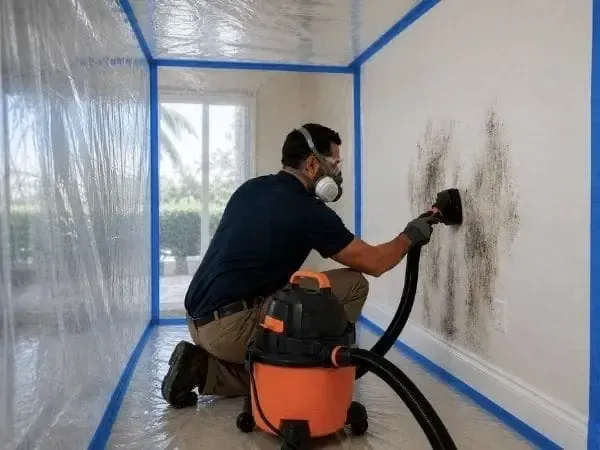
All mold-infested materials are safely removed and disposed of - mold remediation can involve removing drywall, insulation, carpet and other porous building materials with Condition 3 growth. Semi-porous surfaces like wood framing are treated with HEPA vacuums, damp wiping and antimicrobial application. We use commercial-grade air scrubbers and fans throughout the process to ensure air quality remains controlled.
Bleach is ineffective on porous materials as it does not kill the root of the mold, which is why professional techniques involving physical removal are vital.
Step 04
Cleanup and restoration
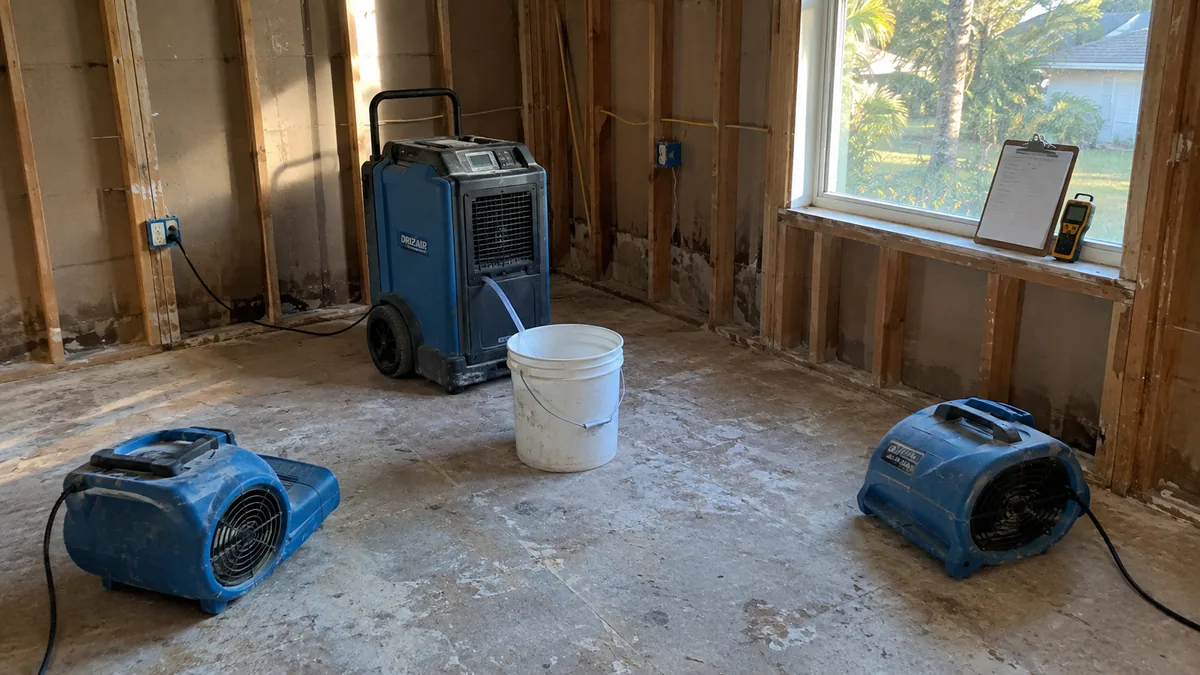
After removal, all affected surfaces receive antimicrobial treatment. We dry the space using industrial dehumidifiers and controlled HVAC systems until moisture readings confirm materials are below safe thresholds (typically under 15% moisture content in wood). Post-remediation verification testing by an independent assessor is recommended, including visual inspection, moisture measurements and air and surface sampling compared to outdoor reference levels.
Once clearance is achieved, structural repairs begin: new drywall, flooring, insulation matched to original R-value and painting. Controlling indoor humidity is essential after mold removal to prevent regrowth.
Worried about mold? A phone assessment is free.
Tell us what you are seeing and we will advise on the best next step.
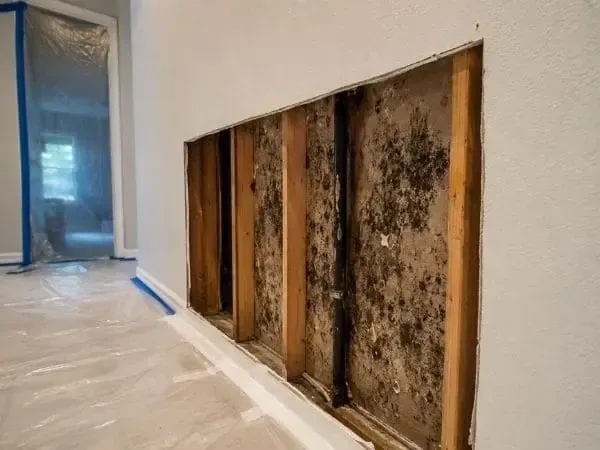
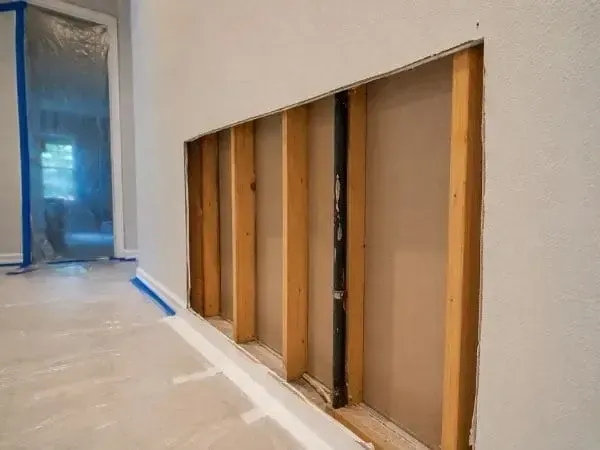
Heavy mold growth inside a wall cavity - full containment, removal of contaminated material, antimicrobial treatment and clearance.
Emergency response · Containment
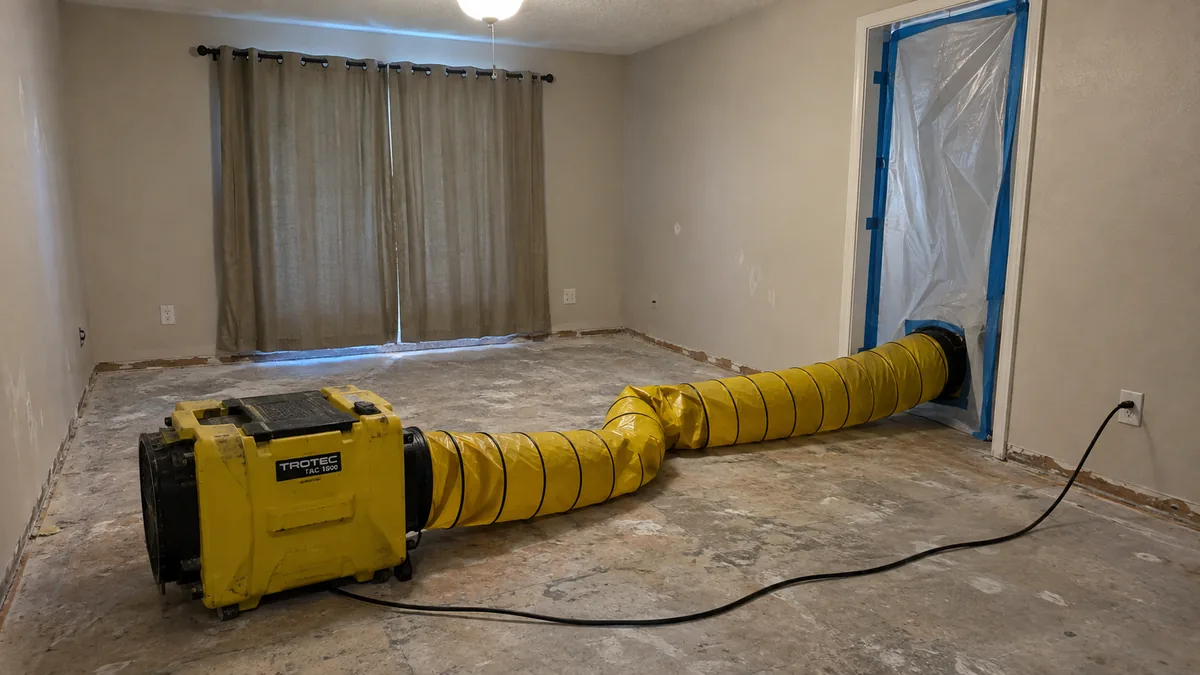
Containment deployed after water damage
Full containment with zipper door and negative air filtration, set up fast to stop mold spores spreading to the rest of the home while remediation runs.
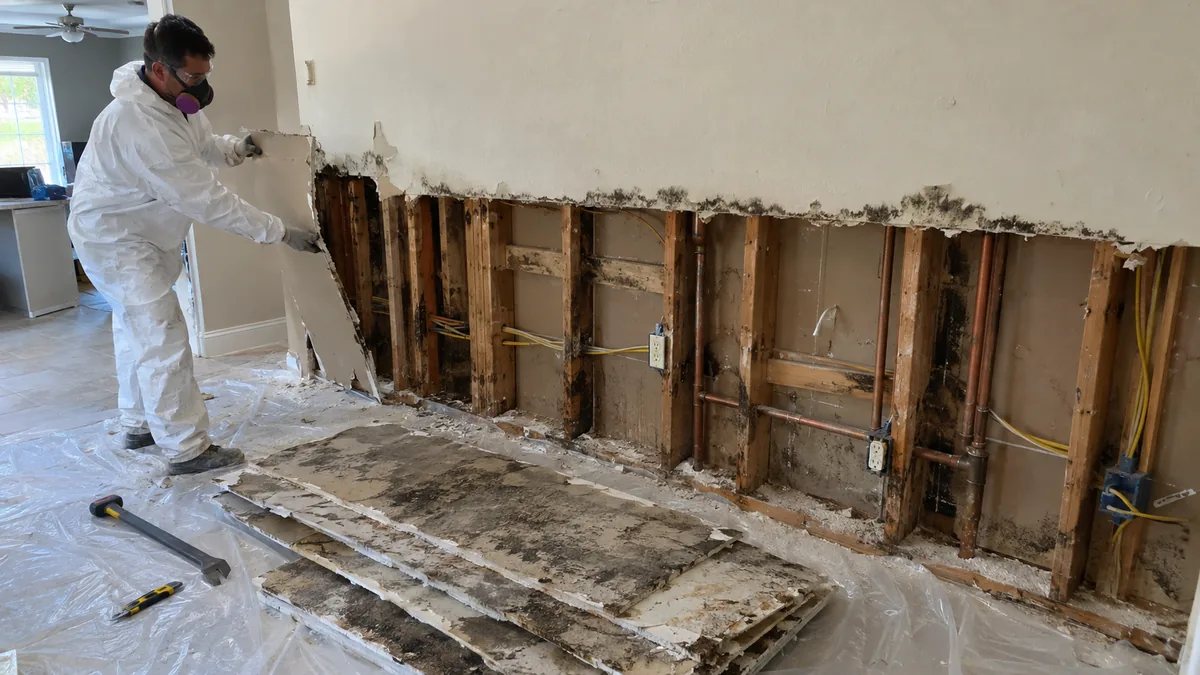
Mold removal · HEPA treatment
HEPA removal inside containment
Visible mold growth treated inside a sealed containment zone - HEPA vacuuming, damp wiping and antimicrobial application, with air scrubbing throughout.
Areas we cover
West Palm Beach and Palm Beach County
We provide mold removal services throughout West Palm Beach and the greater Palm Beach County area.
That takes in the older properties along Flagler Drive and South Flagler Drive, through the Downtown waterfront district, and across neighborhoods including Northwood, Flamingo Park, El Cid, Grandview Heights and Prospect Park.
We also serve the towns of Palm Beach, North Palm Beach and South Palm Beach, plus Palm Beach Gardens, Lake Worth, Delray Beach, Boynton Beach, Boca Raton, Wellington, Jupiter, Riviera Beach and Royal Palm Beach. Zip codes covered include 33480, 33401 through 33422, 33403, 33408 and 33410.
Whether your property is a residential home, a commercial office building or a multi-unit property, our team covers every corner of the West Palm Beach, FL area. If your area is not listed here, give us a call - we will let you know right away whether we can get to you.
West Palm Beach
Palm Beach
North Palm Beach
South Palm Beach
Palm Beach Gardens
Lake Worth
Delray Beach
Boynton Beach
Boca Raton
Wellington
Jupiter
Riviera Beach
Royal Palm Beach
In their words
What customers tell us
“
Found mold behind the bathroom wall during a renovation. They were out the next morning, contained it properly and had the whole area cleared and rebuilt within the week.
“
We had been coughing for months and could not work out why. Turned out there was mold inside the ductwork. The difference after remediation was immediate.
“
They handled our insurance claim from start to finish. Every document, every photo, every lab report. We did not have to chase a single thing.
Common questions
Before you call
Question not answered here? Ask it on the phone. There is no charge for a conversation, and no obligation afterwards.
How much does mold removal cost in West Palm Beach?
Mold removal cost depends on the size of the affected area and what the material is, so no honest figure exists before someone has seen it. Published industry guides put professional remediation at roughly $10 to $30 per square foot, with a localized bathroom job in the hundreds to low thousands and whole-house work running into five figures. HomeGuide and RestoreAdvisor both publish current national ranges.
Treat those as national context rather than a quote. What actually moves the number on a Palm Beach County job is how far the moisture traveled behind finishes, whether the material is porous and has to come out rather than be cleaned, how reachable the affected area is, and whether HVAC ductwork is involved. Many residential policies cover mold damage when it follows a covered peril such as a burst pipe or storm damage.
We will not quote a remediation without knowing where the water came from, because that number would be wrong in the cheap direction. Inspections and estimates are free, so the real figure costs you nothing to find out.
How quickly can you respond to a mold emergency in West Palm Beach?
Response time varies based on current demand, but we aim to have a technician at your property as quickly as possible for emergency calls. Our availability covers weekends, holidays and during storm season when mold emergencies are most common. Contact us by phone for the fastest response.
During peak demand periods after major storms, wait times can increase across the industry. The important thing is to call as soon as you notice water damage or visible mold - mold can spread in as little as 48 hours, so every hour matters.
What health risks does mold pose in South Florida homes?
Mold can produce allergens and irritants that affect everyone differently. Common symptoms include coughing, wheezing, sinus congestion, watery eyes, skin irritation and worsened asthma. People with compromised immune systems, young children and the elderly face greater risks, including potential respiratory infections.
In West Palm Beach's climate, where humidity rarely drops below levels that inhibit mold growth, the presence of mold in your home is not something to put off. If you or your family members are experiencing persistent symptoms that get worse indoors, a professional mold inspection can determine whether mold is the cause.
Is black mold more dangerous than other mold?
Black mold is not automatically more dangerous than other mold, because "black mold" describes a color rather than a single species, and several common indoor molds appear dark on a wall. The species people usually mean is Stachybotrys chartarum, which is a water-damage organism and worth taking seriously as a signal that something has been wet for a long time. The practical response does not change either way: contain the area, remove the porous material rather than treat it, and fix the moisture feeding it. Identifying the exact species rarely alters the work.
Our post on black mold health risks goes through what the evidence does and does not support.
Do you guarantee your mold removal work?
Yes. Every mold remediation project we complete comes with a written guarantee that mold will not return under normal conditions. This guarantee requires that you follow our moisture control recommendations - maintaining humidity below 60%, promptly fixing leaks and ensuring proper ventilation.
Our guarantee includes follow-up inspection to verify conditions remain clean. IICRC standards are followed for mold remediation on every project, and post-remediation verification by an independent assessor confirms the space meets clearance criteria before we consider the job complete.
Can I remove mold myself?
For very small, surface-level patches on non-porous materials like tile grout, homeowner cleaning may be sufficient. Florida's licensing statute defines mold assessment and remediation as work on growth larger than 10 square feet, so above that size the work falls under the licensing regime. Mold on porous materials, hidden behind walls, or inside HVAC systems needs a professional regardless of size.
DIY efforts risk spreading mold spores, incomplete removal and no insurance recognition. Bleach is ineffective on porous materials as it does not kill the root of the mold, which is why professional remediation with proper containment and HEPA filtration is the only reliable approach.
Does insurance cover mold removal in Florida?
Many residential insurance policies cover mold damage when it results from a covered peril like a burst pipe or storm damage. We work directly with your insurance company to document the claim and help ensure covered costs are reimbursed. We provide the documentation, moisture readings, photographs and lab reports they require.
Why is bleach ineffective for mold removal?
Bleach only kills surface mold on non-porous materials. On porous surfaces like drywall, wood and carpet, bleach does not penetrate to the root structure. The surface appears clean but the mold regrows from beneath, often within days. Professional remediation involves physical removal of contaminated materials, HEPA filtration and antimicrobial treatment, which is the only reliable approach for porous materials.
What does a professional mold inspection involve?
A professional mold inspection uses thermal imaging to find temperature differences behind walls and ceilings, and moisture meters to measure how wet drywall, wood and flooring are, so the moisture source is located before any work begins. You get a written report of the findings and a remediation scope.
Where laboratory testing is needed, air and surface sampling is done by an independent licensed assessor. Typical costs and how testing fits in are on the mold inspection and testing page.
When do I need mold testing instead of removal?
Mold testing makes sense when you suspect a problem but cannot see it - a musty smell with no visible growth, unexplained allergy symptoms, or after a past leak you are not sure was fully dried. Testing is also common before buying or selling a property, or when a landlord or insurer needs documented evidence.
If mold is clearly visible, testing is usually unnecessary - the priority is removal. We advise honestly on the phone which you actually need.
How long does mold remediation take?
Most mold remediation projects take three to five days depending on the size and scope of the contamination. Emergency containment is deployed within hours of the initial call. Post-remediation verification testing by an independent assessor is recommended before the job is considered complete. Larger projects involving structural repairs and property restoration will run longer.
 Before
 After